Where the Aventon Level 4 REC makes its case
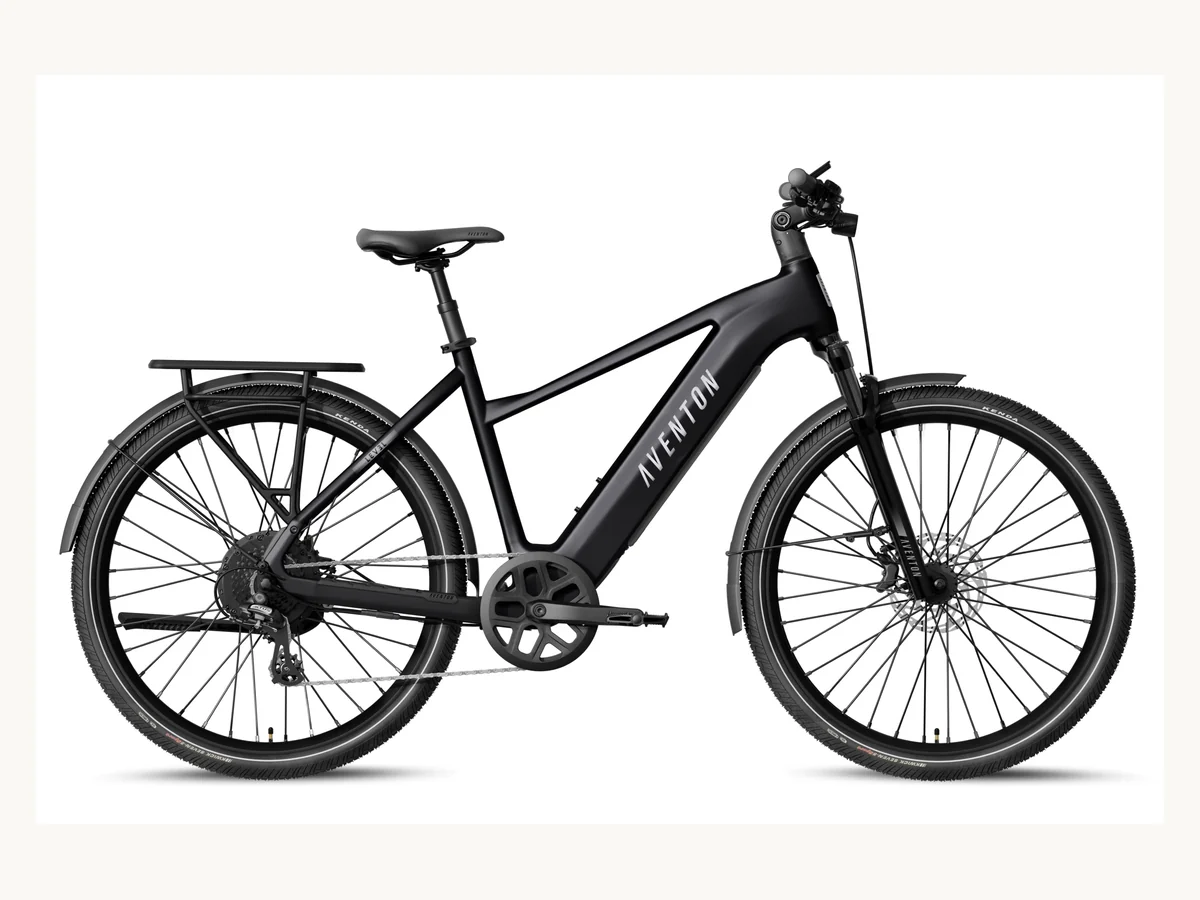
- The 733 Wh battery supports a 75-mile claimed range, and the sensor switch lets riders choose between torque and cadence behaviour.
- At 68.5 lb, it is roughly six pounds lighter than the Radster Road in the published Regular configuration.
- 4G/GPS tracking, unusual-activity detection, an electronic lock, and a wheel lock bring security into the bike itself.
- The 80 mm suspension fork, suspension seatpost, rack, fenders, integrated lights, and turn signals make it a complete commuter package.
Where the Radster Road still earns attention
- The 750 W Rad rear hub is rated at 100 Nm, giving it a torque advantage on the specification sheet.
- The 320 lb total payload includes a 290 lb maximum rider, while the rear rack is rated for 55 lb.
- Five torque-sensor assist levels plus zero assist provide more granular control than the Aventon's three levels and Boost mode.
- Rad's deeper accessory range makes it easier to build a cargo- or utility-focused system around the bike.
Radster Road vs Aventon Level 4 REC specifications
| Specification | Radster Road | Aventon Level 4 REC |
|---|---|---|
| Motor | 750 W rear hub, 100 Nm | 750 W rear hub; 1,188 W peak, 80 Nm |
| Battery | 48 V, 15 Ah, 720 Wh | 36 V, 20 Ah, 733 Wh |
| Claimed range | 25–65 miles | Up to 75 miles |
| Pedal assist | 5 levels, torque sensor | 3 levels plus Boost; switchable sensor |
| Speed / class | 28 mph; Class 1–3 switchable, ships Class 2 | Class 2 standard; Class 3 capable |
| Bike weight | 74.5–75 lb | 68.5 lb |
| Payload | 320 lb total; 290 lb rider | Confirm exact current listing |
| Cargo hardware | Rack rated 55 lb; fenders included | Rack and fenders included |
| Brakes | Hydraulic disc | Tektro 2-piston hydraulic disc |
| Security | Passcode-protected controls | 4G/GPS, alarm, activity detection, locks |
| Warranty | 2-year limited | 2-year limited; lifetime frame |
Reference configurations: Radster Road Regular and Aventon Level 4 REC. North American manufacturer specifications; verify the exact listing before purchase.
Rad Power Bikes vs Aventon in one minute
The Radster Road and Aventon Level 4 REC meet as two practical commuter bikes with hydraulic brakes, integrated lights, fenders, racks, and roughly similar purchase positioning. The split is in weight, torque, fit, assist tuning, and digital security.
Aventon's advantage is not a single headline figure. It is the combination of lower weight, a wider security feature set, and the ability to switch sensor behaviour. Rad's strongest case is a 100 Nm motor, a useful 55 lb rear-rack limit, and a utility ecosystem for riders who plan to carry a lot.
Ride feel starts with the sensor and tuning
Both bikes now use torque sensing. That matters because older assumptions about one brand feeling smooth and the other feeling like an on-off switch are too blunt for the current Radster generation.
The Aventon adds a sensor switch. It is useful when a rider wants cadence-style assistance for a particular trip or torque-based assistance for a more natural pedal response. The Radster Road's five assist levels and zero-assist mode give it finer steps in normal use.
These are control strategies, not proof that one bike is faster. Controller tuning, gearing, tyres, and rider weight will decide the experience.
Battery and range: compare the whole system
The batteries are close in stored energy: 720 Wh for Radster Road and 733 Wh for Level 4 REC. Aventon publishes a higher best-case range at 75 miles versus Rad's 25–65-mile estimate, but best-case range is not a commute guarantee.
Aventon's lower system voltage and different motor control can support efficiency, while Rad's 48 V system and stronger torque rating shape how power is delivered. Assist level, speed, temperature, hills, cargo, and throttle use will create a larger difference than the 13 Wh gap.
Fit matters more than the brand comparison
Radster Road geometry covers riders from 4 ft 11 in to 6 ft 4 in across Regular and Large frames, with frame-specific standover heights. Aventon's Level 4 platform is offered in step-over and step-through forms, with more than one frame size and a published fit range.
Do not choose from the top tube alone. Check reach, standover, seat height, and whether you can touch down with the bike loaded. A six-pound weight saving cannot rescue a cockpit that puts pressure on your hands or a frame you cannot manage at a stop.
Commuting features that change ownership
The Level 4 REC is the more integrated technology package. Its 4G/GPS connection, electronic lock, wheel lock, unusual-activity detection, and smartphone notification system may be valuable for apartment or street parking. Security electronics are a convenience, not a substitute for a good lock.
The Radster Road's utility case is straightforward: a 55 lb rack rating and a broad compatible-accessory range. If the bike replaces short car trips for groceries, work gear, or a child seat, cargo support should outweigh a small difference in peak motor output.
What this comparison does not prove
This is an independent desk review, not an instrumented road test. We have not measured brake stopping distance, motor heat, real range, vibration, or dealer support in this comparison.
The correct next step is local: ride both where possible, confirm the exact frame size and current battery certification, and ask who will service the motor, controller, brakes, and software in your area.
The verdict: Aventon for integrated commuting, Rad for torque and utility
Choose the Aventon Level 4 REC if lighter weight, connected security, and a more compact fit are your priorities. Choose the Radster Road if you want more rated torque and a power system oriented around utility and carrying. Neither published specification proves the better bike for your body and route.
Check the current listing
We do not publish a stale price. Confirm the exact model, variant, delivery estimate, and included parts at the destination.
Affiliate link. We may earn a commission at no extra cost to you.